

Most cricketers have never seen a bat made. They see the finished article in a wrapper with a sticker on it, and everything before that is a mystery. Here is what actually happens between a tree in England and a bat in your hands.
1. The willow
It starts as Salix alba caerulea, English willow, grown on wet ground in the east of England. A tree is felled at around 15 to 20 years old, cut into rounds, and those rounds are split into wedge-shaped clefts. One tree yields somewhere between 20 and 40 bats.
Each cleft is air dried and kiln dried down to a moisture content of around 12%. Too wet and it will not press. Too dry and it goes brittle. The end grain is waxed to stop it drying unevenly.
2. Grading and selection
The clefts arrive from our supplier in England and this is where the decisions start. We sort by the face: grain count, straightness, cleanliness, marks, red wood on the edge. That sort determines the grade.
There is one exception. For our Featherblade grade we ignore the face and go straight to the scales, because we are hunting for naturally low-density clefts. The weight is written on the face of every cleft before a single cut is made, and that number decides what the bat can become.
3. Pressing
The most important step, and the one nobody sees. The cleft goes through a heavy roller under enormous pressure, which compresses the surface fibres of the face into a hard, springy skin over the softer wood beneath.
Get it wrong in either direction and the bat is ruined before it exists. Under-press and the face dents and dies within weeks. Over-press and you crush the life out of the willow, and it will never ping no matter how well you knock it in.
This is the single biggest difference between a good bat and a bad one, and it has nothing to do with the number of grains on the face.
4. Cutting the splice and fitting the handle
A V-shaped slot is cut into the shoulder of the cleft, and a matching V is cut into the base of the handle. The two are glued together under clamps.
The handle itself is a laminate of Sarawak cane with rubber inserts running through it. Those rubber layers are what absorb shock and give the handle its flex. More rubber means more give and a springier feel; less means a stiffer, more direct handle. The number of pieces varies with what the bat is for.
5. Shaping the blade
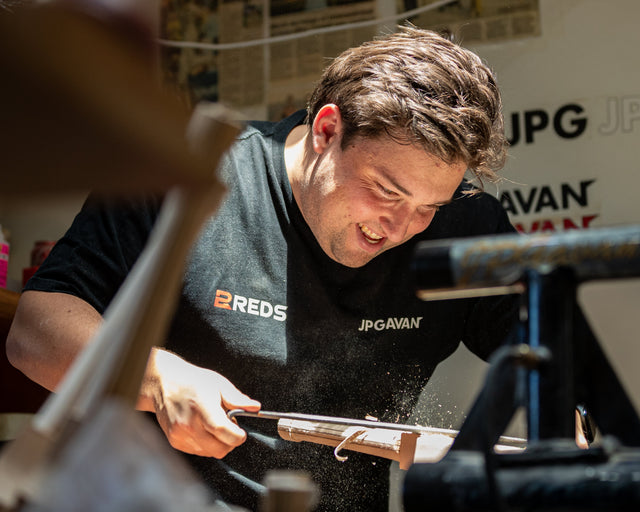
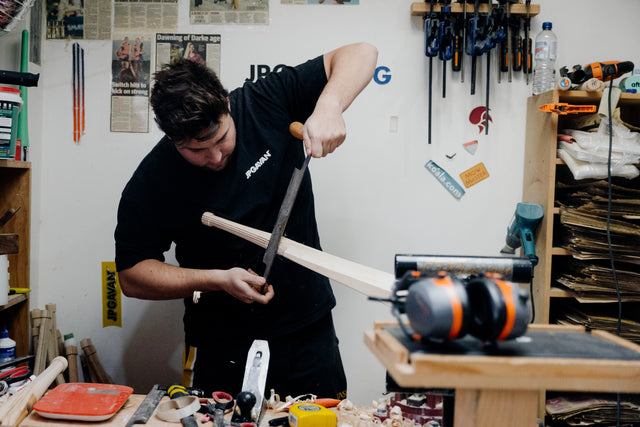
This is where a piece of pressed wood becomes a cricket bat, and it is done by hand with a draw knife, spokeshave and plane.
- The spine is drawn down the back and the peak is set at the sweet spot. Where we put that peak decides whether the bat plays as a low, mid or high middle.
- The edges are cut in, typically around 40mm, with the spine running around 62mm at its peak.
- The concaving is carved between the edge and the spine: full for straight planes, semi-concaved for a gentle curve, or concaved for a deep sweep and a sharp spine peak. This is what lets us take weight out of the back without touching the edges.
- The toe is finished square (flat with rounded corners) or round (marked 15mm up each edge and rounded evenly).
- The shoulders are shaped and the handle is blended into the blade.
Every one of those cuts changes the weight and the balance. The maker is constantly weighing, feeling the pick-up, and adjusting. A standard Short Handle bat is a 300mm handle and a 550mm blade, and the whole thing has to come in on the weight the customer asked for.
6. Sanding, finishing and binding
The blade is sanded through progressively finer grits until the face is smooth, then polished. The handle is bound with twine and a grip is fitted. A binding goes around the blade to hold the edges. A toe guard is fitted if the bat is going anywhere near an Australian pitch.
7. Stickers and the last check
The stickers go on last, and then the bat gets weighed one final time and picked up one final time. If it does not feel right, it goes back on the bench.
Why we still do it by hand
Josh started making bats at 16, in a shed, while he was still at school. At 18 he flew to India and spent two weeks on the floor of a bat factory learning the craft from people who make thousands a year. He has been at it full time since 2016.
A machine can copy a shape. It cannot pick up a cleft, feel the weight, look at the grain and decide what this particular piece of wood wants to become. That decision is the whole job.
Every bat starts with the same set of choices we make on this bench: grade, weight, middle, edges, concaving, toe. You can make those choices yourself in our custom bat builder, and we will build it to your spec.


0 comments